FinancieelSlim · Client work
From financial education to mortgage advice, without starting over
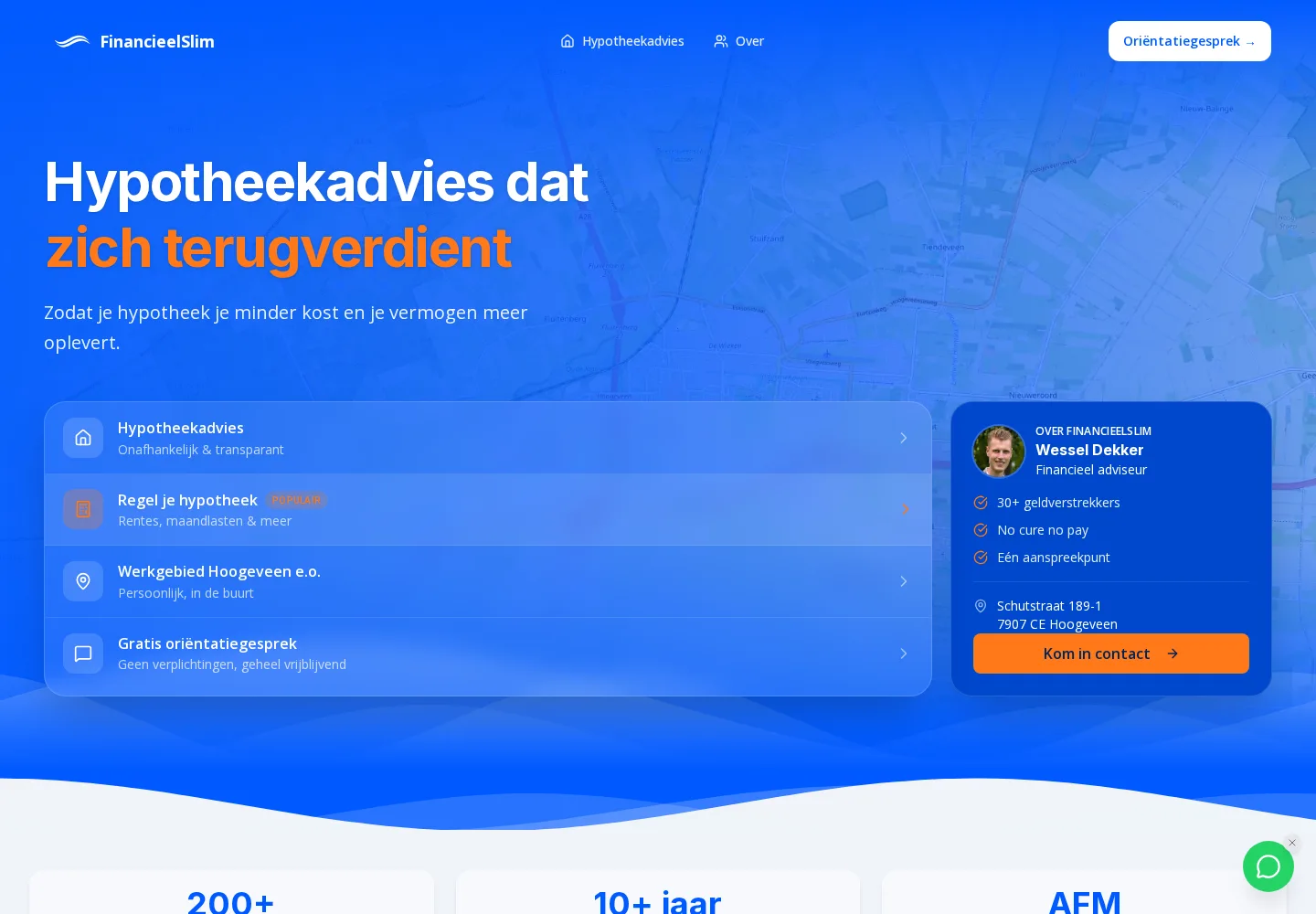
Started as an education platform with calculators, paid services and a content hub. Once the AFM licence came through, the site switched to mortgage advice in four weeks, with local pages for search demand that turned out to exist already.

- Project type
- Client work
- My role
- Design, development and reworking
- Status
- Website online
- Duration
- 1 month to build, 4 weeks to rework
- Team size
- 1
- Investment
- ~€2,000 (first delivery)
- The question
- An education platform needed to support mortgage advice while keeping its existing content and calculators.
- The result
- From education to mortgage advice, keeping the editor, calculators and content hub.
The question
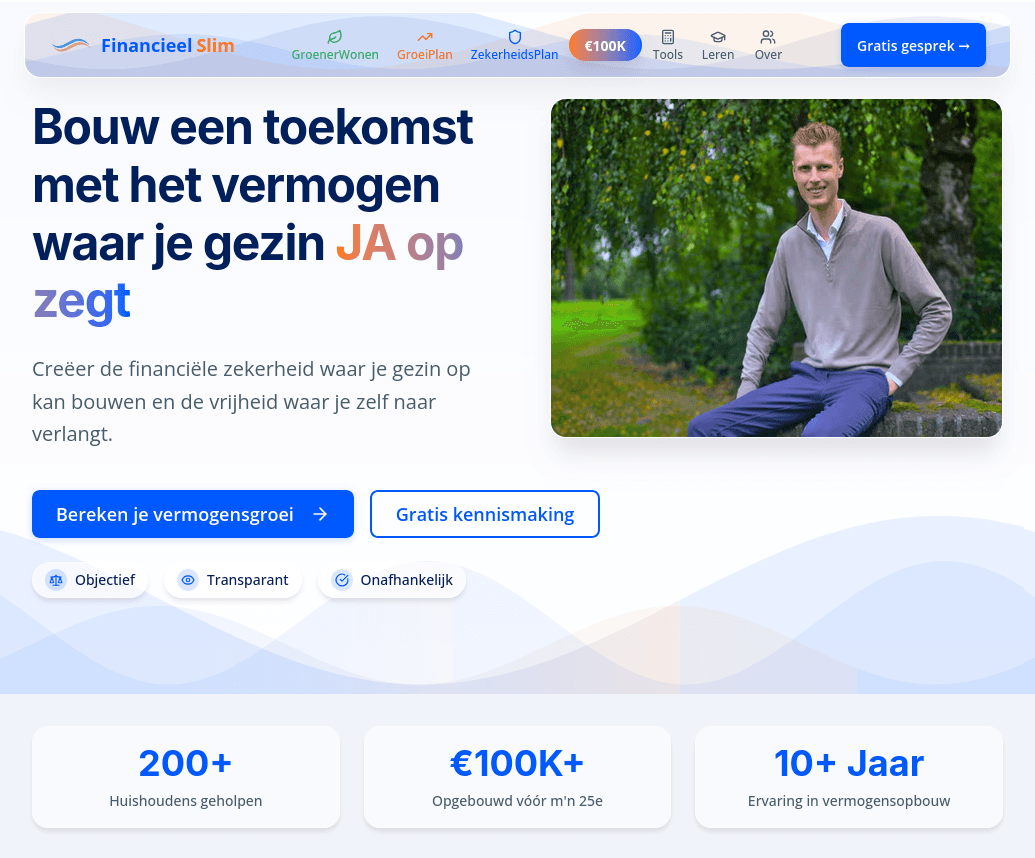
FinancieelSlim started out with a page the owner had put together in a site builder: hard to find, without any tools and with no way to turn a visitor into a client. Within a month there was a platform with calculators, paid services, a content hub and an editor in which the owner manages everything. When the licence from the AFM, the Dutch financial regulator, took effect half a year later and the firm could also advise on and arrange mortgages, nothing had to be rebuilt: the site switched to mortgage advice in four weeks, with the educational content kept as a side track that feeds the new main route.
At the start the problem was simple: there was a growing following on social media, but nothing online that lived up to it. The existing site had been made with a site builder, hardly showed up in search, had no tools at all to show the expertise, and no way for a visitor to become a client. One month, about two thousand euros.
Half a year later came the more interesting problem: the licence took effect. Suddenly the firm was allowed to do something new, mortgages, and the entire site was still about something else. Services, prices, frequently asked questions, the layout of the homepage: everything had been built around an offer that was no longer the main one. And that is not something you can do halfway; a licensed adviser whose site still says otherwise is a problem.
Key issues
- A DIY site-builder page with no search visibility and no authority
- No tools that let a visitor experience the expertise before paying
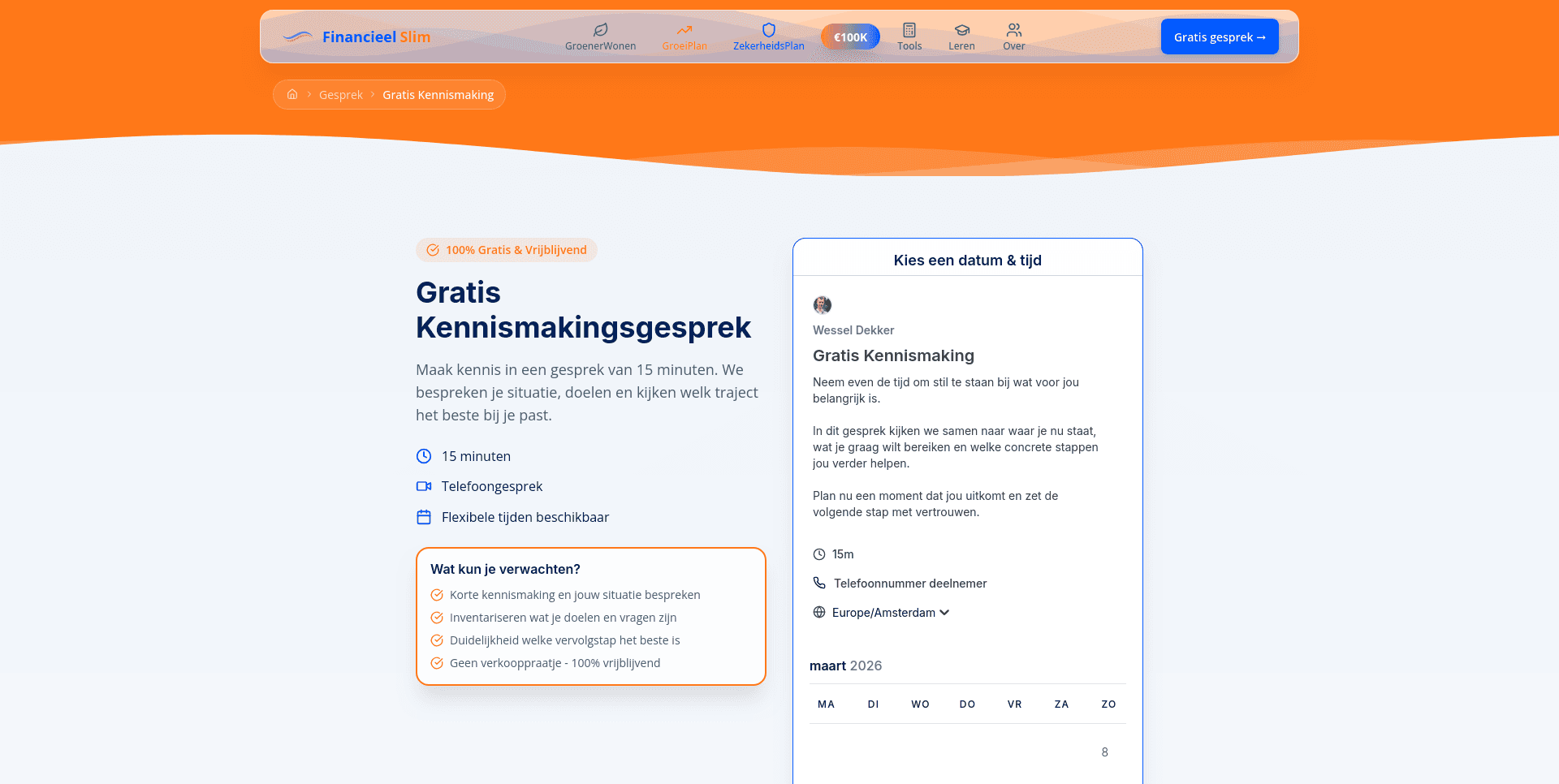
- No way to book a meeting or pay for a service
- Half a year later: a new licence the site said nothing about
- Searches for mortgage advice in the surrounding villages ended up on the homepage, which had no answer
Without a platform, the growing following on social media stayed exactly that: followers. There were no tools that showed the expertise, no way to book a meeting and no way to pay, so everything ran through manual back-and-forth messages. After the licence came a second cost: every visitor looking for mortgage advice read a site that did not mention it yet.
Constraints
- One month and about €2,000 for the first delivery
- Every calculator had to be correct under Dutch regulations; mistakes here are not cosmetic
- After delivery, the owner had to be able to carry on fully independently
- For the switch: no rebuild, the licence had already taken effect
The client had built a site with a site builder. Fine as a temporary presence, but without the structure, search visibility and tools needed to compete seriously in the Dutch market for financial advice.
Project background
FinancieelSlim is an independent financial adviser in Hoogeveen, in the north-east of the Netherlands. More than ten years of experience in the financial sector, over two hundred households helped, and a position that is the exception in this market: no commissions and no ties to a single bank.
Since May 2026 the practice has held an AFM licence, which means it can also advise on and arrange mortgages, with access to more than thirty lenders. That changed the business, and with it what the site had to do.
My approach and decisions
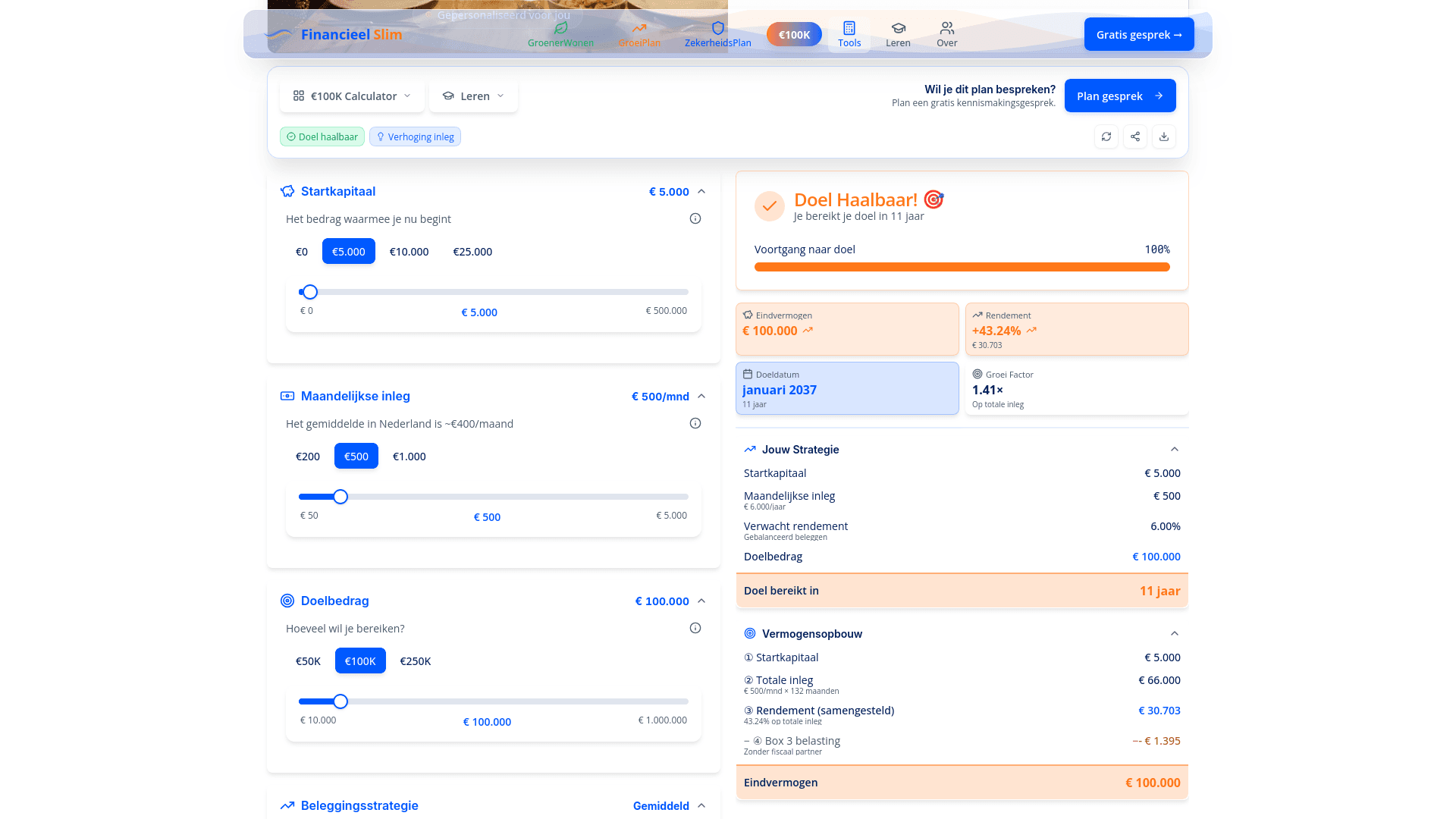
Free tools to earn trust. Five calculators (building wealth, box 3 wealth tax, saving for a first home, cutting back on work early and, since the switch, the monthly mortgage payment) let a visitor experience the quality of the advice before paying anything. For four of them the result can be taken away as a PDF. In financial advice, that convinces people more than any sales copy.
An editor built into the site, from day one. The owner manages all content without me. That was the set-up from the first delivery, and it is exactly why the switch half a year later did not turn into a rebuild.
For the switch: first look at where demand already existed. The search data showed that people from Hoogeveen and the surrounding villages were already searching for mortgage advice in their own town, and kept landing on the homepage, which said nothing about it. They got their own pages, for thirteen towns and eight situations such as refinancing, renovating and making a home more energy-efficient, with one hard rule: a town page only exists once there is real, published content for it. Otherwise you are building doorway pages that help nobody.
Three systems out. The booking system, the payment system and the customer system have all been removed; appointments, payments and invoices now run through the mortgage platform the practice works on. Removing the payment integration alone took out more than 8,000 lines of code. The site now does what it does best: get found and start conversations.
FinancieelSlim found BVDNET through LinkedIn and wanted one party for the whole job: design, build, search visibility and calculators that have to be right down to the decimal.
Why this approach
- One point of contact from design to launch
- Calculators verified and tested against Dutch rules
- Search visibility and structured data from the first version
- Delivered within a month
- After launch, the owner manages everything
Expertise used
Technical details
Technologies used
- Next.js
- React
- TypeScript
- Sanity
- Resend
- React PDF
- Recharts
- Vercel
- Sentry
- Playwright
- Vitest
What it delivered
The first delivery came within the month and within budget. Growth in search visibility was large, more than twentyfold, but that figure needs context: the starting point was a site-builder page with almost no authority, and growing from close to zero goes fast. What is there now does hold up: full indexing, structured data and local pages that rank for their own search terms.
The result I value most is the second one: when the business changed, the site did not have to be rebuilt. Turning the education platform into a mortgage platform took four weeks, while the foundation (the editor, the calculators, the content hub) simply stayed in place. The educational content was not thrown away but given a supporting role, and has fed the mortgage pages with background articles ever since.
On speed: the time the homepage did not respond to input went from 320 to 24 milliseconds, a 92% improvement. At 4.8 seconds, the load time of the largest element is still above the standard we hold ourselves to; that is still open and being tracked.
- Organic search visibility
- More than twentyfold, from close to zero
- Close to zero (site builder, no authority) → Fully indexed, with its own local pages
- Switch to mortgage advice
- Four weeks, without a rebuild
- Site was entirely about the old offer → Mortgage hub with 13 towns and 8 situations
- Calculators
- Verified and tested
- 0 → 5, of which 4 with PDF export
- Homepage responsiveness
- 92% less
- 320 milliseconds blocked → 24 milliseconds
- Systems to maintain
- Three subscriptions cancelled
- Separate booking, payment and customer systems → One integration with the mortgage platform
Delivered
- Complete platform in one month, on budget
- Switched to mortgage advice in four weeks, without a rebuild
- 5 calculators, 4 with PDF export
- Pages for 13 towns and 8 situations
- The owner manages content, rates and new pages
Outcomes
- Visitors experience the quality of the advice for free, before paying anything
- The owner publishes a new town page without anyone having to deploy
- Figures from Statistics Netherlands (CBS) come straight from the source; if the source drops out, only that block disappears
- A town page only exists once there is real content for it; no empty doorway pages
- The knowledge base still exists and now feeds the mortgage pages with background
- The owner updates mortgage rates, including the date of the update
What I take forward
Lessons
- A platform the owner manages can move with the business; that is a return you only collect later
- In financial advice, free tools that are correct convince people more than sales copy
- Growth figures from a base of close to zero belong next to that context
- Only build a local page once there is real content for it; otherwise you are making a doorway page
- Replacing three separate systems with one integration saves maintenance and subscriptions
- Look at where the search demand already is before you come up with pages
The platform is built on independence, and that has now been proven twice: the owner publishes articles, adjusts prices and rates, and adds new town pages without a developer. When the business changed its offer, that same foundation made the difference between four weeks of rework and starting over.