






Skip to content
BVDNET
ServicesWorkPricing
About
CVCSS 3D lab3D gallery
BlogDictionary
Contact
Music production, performance & DJAlgorithmic artPhoto- & videography + editingPrint & color correctionAnalog electronics & audioCNC machiningCAD & 3D printingFPV drones (acro)Repair & refurbishmentPhilosophy, psychology & cognitionMetaphors & analogiesAstronomy & spaceflightBuilding with code & AI agents
Moodboard

Who I am,
in interests.

My interests look like a messy list — music, lathes, drones, telescopes, algorithmic art, broken phones. They're not. It's always the same person doing the same thing: finding the rules underneath something, taking it apart to understand it, and then rebuilding it better or making it anew. Whether that material is sound, metal, light or code barely matters to me. It's one way of seeing, applied to a different medium each time.

To my CV →Enter the 3D gallery →
BVDBVD
1 / 13
Music production, performance & DJ

Orchestrating rules and laws, without obligation.

Composing and producing is systems thinking: harmony, rhythm and arrangement are rule sets you know in order to break them deliberately, and the signal chain underneath (gain staging) is pure engineering.

to the topic →
2 / 13
Algorithmic art

I'm the intuitive operator of a fundamental algorithm.

I make algorithmic art; generative art is one branch of it. My primary work: using a cash-register keypad I apply convolution by feel — sharpening, blurring — until arresting abstract images emerge.

to the topic →
3 / 13
Photo- & videography + editing

Capturing a state — artificial or natural.

For me photography is capturing a state, with as few means as possible.

to the topic →
4 / 13
Print & color correction

Bringing the digital into the real world, pixel-perfect.

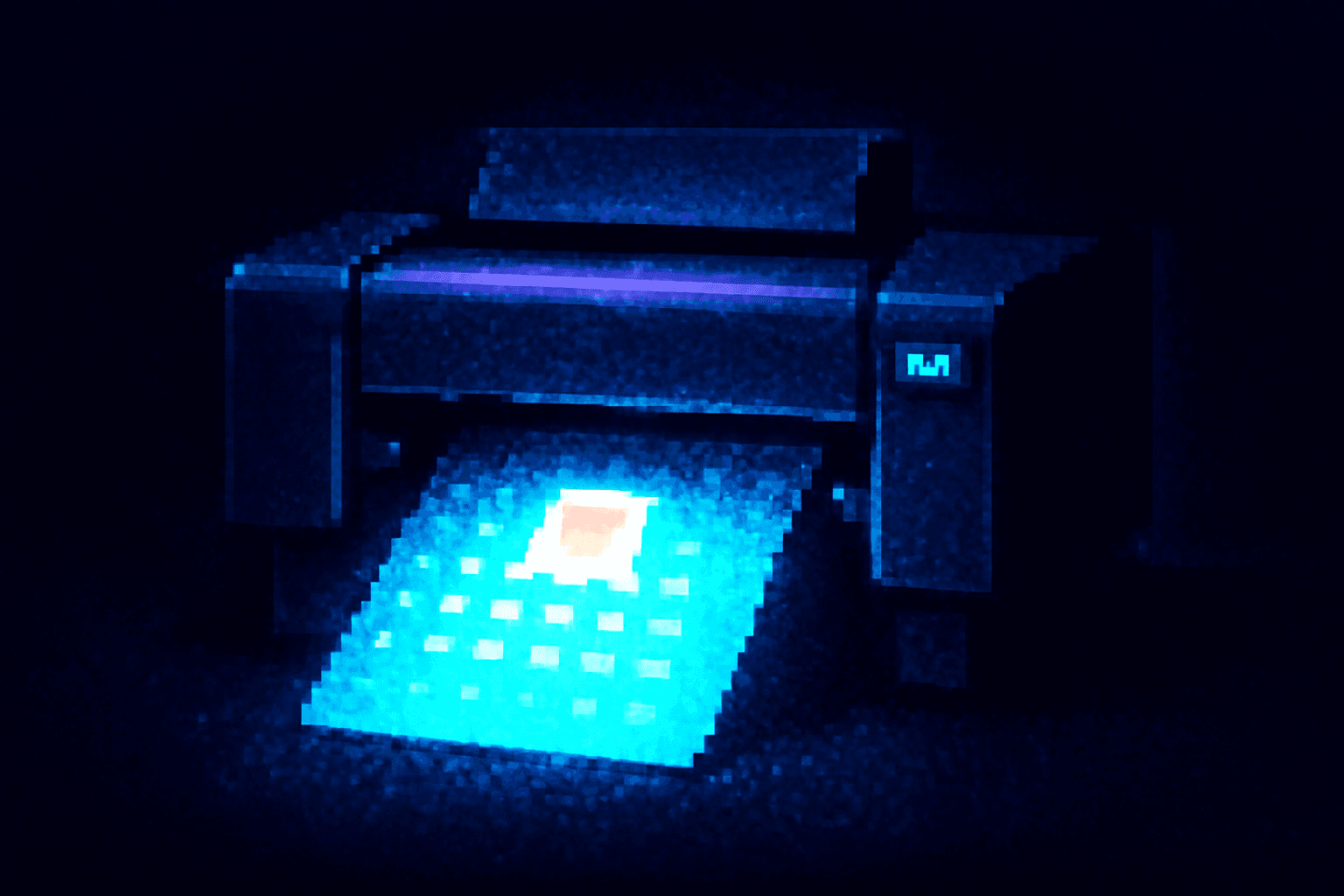
With modified inkjets (Epson R2100/R2400) I bring my work physically into the world. The technique grew out of a requirement: my art (64×64 to 512×512px) has to come out pixel-perfect and crisp at scale.

to the topic →
5 / 13
Analog electronics & audio

A system you can fully see and measure.

Analog electronics (and the audio that comes out of it) is fun because the low-level system is almost fully visible and measurable: no spec sheets needed to understand or troubleshoot it.

to the topic →
6 / 13
CNC machining

The machine that produces on its own for days on end.

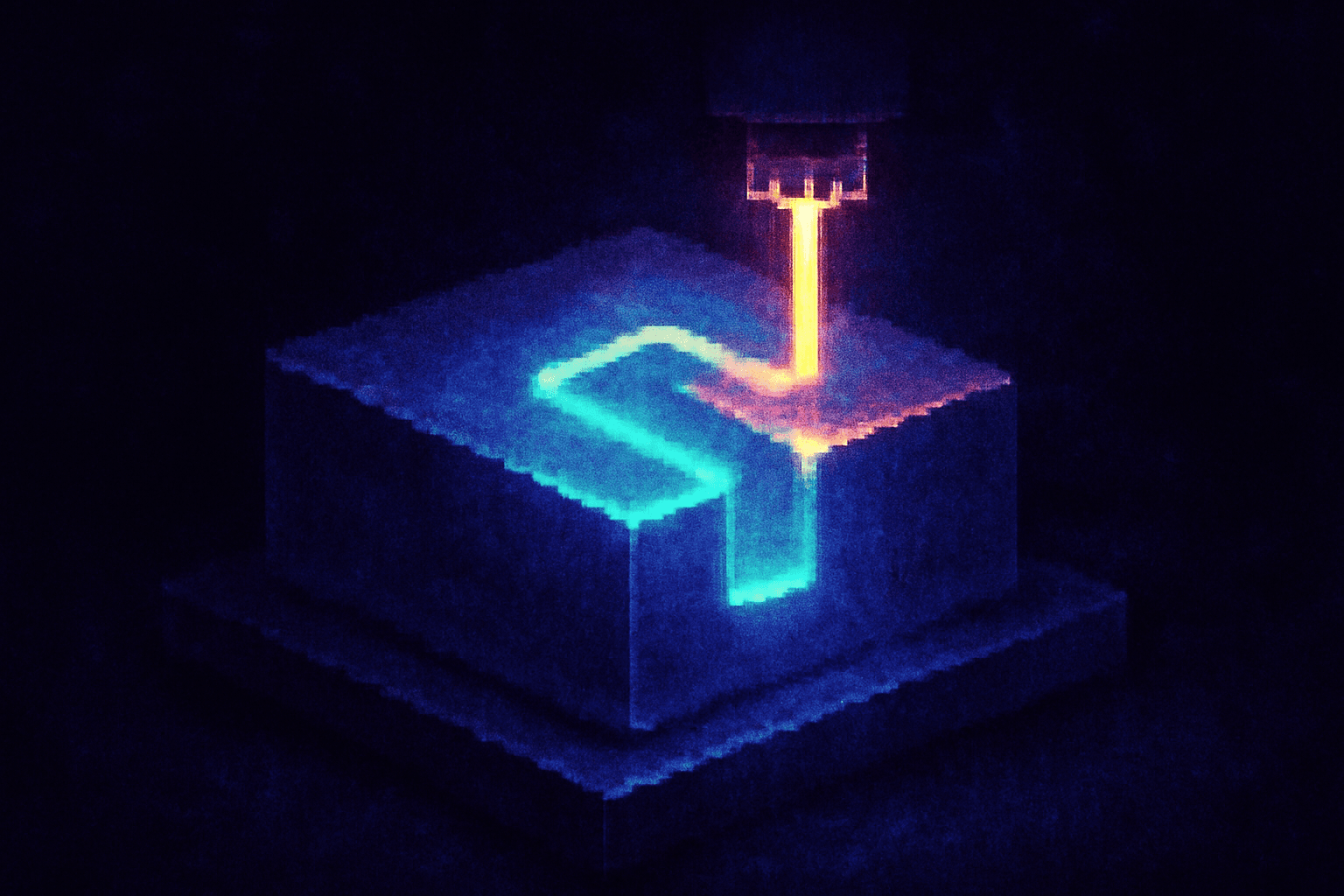
As an apprentice machinist I programmed, set up and operated CNC machines and automation robots. The real work is the program that lets the machine produce autonomously and with as little downtime as possible.

to the topic →
7 / 13
CAD & 3D printing

A tool within reach, not a love in itself.

CAD and 3D printing are more tools to me than an intrinsic interest.

to the topic →
8 / 13
FPV drones (acro)

Respect the trajectory.

In acro mode the drone doesn't stop when the throttle closes — the trajectory keeps going, and for even a 'simple' turn I manipulate all axes at once.

to the topic →
9 / 13
Repair & refurbishment

First understand why, only then the screwdriver.

My default is intuitive: grab a screwdriver and fix things by feel, which almost always works. I only follow a procedure when the stakes are high (expensive, not my own product — like at Coolblue) or when it isn't solvable straight away.

to the topic →
10 / 13
Philosophy, psychology & cognition

The brain is just an unsteered stream of thought too.

What really fascinates me is the overlap between how a brain works and how an LLM or agent works. The stream of thought you don't fully control resembles a model's generation; and the brain few-shot-prompts itself from a feeling — a depression loop is in effect a self-reinforcing prompt that colors everything that follows.

to the topic →
11 / 13
Metaphors & analogies

The most compact unit of communication there is.

I'm crazy about metaphors. With no particular prompting I find myself building a strong analogy, with the bar being: my mother has to get it. It's about compressing something complicated into the smallest possible unit that conveys it.

to the topic →
12 / 13
Astronomy & spaceflight

Putting reality in perspective and in place.

For me astronomy is mostly about perspective: how the (im)balance across the whole horizon is what put me here, and — with a generous over-generalization — that I'm describing that very thing by way of an entity that itself arose entirely from natural raw materials. Systems thinking at the largest level.

to the topic →
13 / 13
Building with code & AI agents

Where all the threads come together.

Since mid-2025 I've been building full-time: full-stack in TypeScript and Python, terminal-first with Claude Code and multiple models. It feels like music, metal, image and language compressed into one medium — the same instincts, in a new material.

to the topic →
The graph · the four threads

Everything converges on one point.

Pick a thread to see only those nodes — or hover over the graph.

Music / DJAlgo artPhotographyPrintingAudio / electronicsCNCCAD / 3D printFPVRepairPhilosophyMetaphorsAstronomyBuilding with code & AI
Music production, performance & DJ

Orchestrating rules and laws, without obligation.

Modelling whoever receives your output is a design instrument, whether that's a listener, a user, or the model I'm prompting. Good building starts with a sharp picture of the receiver.

to the topic →
Algorithmic art

I'm the intuitive operator of a fundamental algorithm.

Convolution is the core operation of image processing and of convolutional neural networks: I'm playing with exactly the building block modern vision runs on. Being the human-in-the-loop of an algorithm — steering, turning the dials, critically choosing what stays — is the same role I play with an LLM.

to the topic →
Photo- & videography + editing

Capturing a state — artificial or natural.

Choosing the right tool and getting the maximum out of minimal means is exactly how I build (FSL runs on €0/month). The 640×480 that just “happens” to be web-perfect already is the constraint that is itself the optimization. And curating from a heap down to a series is the same critical selection as judging what an agent produces.

to the topic →
Print & color correction

Bringing the digital into the real world, pixel-perfect.

Nearest-neighbor over bilinear is deliberately choosing the algorithm because the artifact demands it; the same precision as choosing the right data structure or interpolation in code. And getting top quality out of a dead instrument, open source and knowledge is exactly my ethos: maximum result from minimal means.

to the topic →
Analog electronics & audio

A system you can fully see and measure.

A system you can fully see and measure is the opposite of a black box; it's the joy of full observability, where you can reason directly without a layer that hides your errors. And seeing the same function solved once in hardware and once in code sharpens the awareness that a problem has multiple implementations.

to the topic →
CNC machining

The machine that produces on its own for days on end.

This is exactly how I think about code now: a system that runs autonomously and reliably, with error handling and graceful degradation (tool wear = a degrading dependency), deliberate architecture choices with trade-offs, and micro-optimizations that add up at scale. BVDART Ops is at its core the same problem: keeping production running autonomously without it falling over.

to the topic →
CAD & 3D printing

A tool within reach, not a love in itself.

This is pragmatism: the right tool within reach to quickly get something working. The short turnaround from idea to physical thing is prototyping; pushing cheap hardware to its limit is the same game as with the inkjet.

to the topic →
FPV drones (acro)

Respect the trajectory.

A system with momentum that can't be paused, you steer by respecting its state and correcting ahead instead of fighting it. And the flow state itself is my natural working mode: full immersion in the mission of the moment.

to the topic →
Repair & refurbishment

First understand why, only then the screwdriver.

Cause-and-effect thinking and getting to the bottom of the system is debugging from understanding rather than from a runbook. And the stakes trade-off — fast and intuitive where being wrong is cheap, careful where it's expensive — is an engineering instinct I use daily.

to the topic →
Philosophy, psychology & cognition

The brain is just an unsteered stream of thought too.

Whoever understands how thinking steers itself (and derails) steers a model better too: a feeling that colors your thoughts is a context that colors your output, and managing your own attention closely resembles context management. Understanding cognition and steering agents are, to me, the same subject.

to the topic →
Metaphors & analogies

The most compact unit of communication there is.

This touches every AI interaction: a model sometimes grasps a metaphor more cleanly than a technical wall of text, and regularly comes up with apt analogies itself. Compressing complexity into a transferable unit works for human and model alike — and “my mother has to get it” is the sharpest clarity bar there is.

to the topic →
Astronomy & spaceflight

Putting reality in perspective and in place.

Putting scale in perspective keeps me sharp on what really matters. And early spaceflight is the ultimate minimal-means story: making the impossible controllable with almost nothing — exactly the challenge that energizes me, whether it's a probe or a platform on €0/month.

to the topic →
Building with code & AI agents

Where all the threads come together.

There's no parallel here anymore; this is where they all converge. Every other node gave me an instinct that comes together here: the model of the receiver, playing the building blocks, designing-for-what-goes-wrong, root-cause, and compressing complexity.

to the topic →
Music production, performance & DJ
Musicproduction,performance&DJ

Orchestrating rules and laws, without obligation.

Composing and producing is systems thinking: harmony, rhythm and arrangement are rule sets you know in order to break them deliberately, and the signal chain underneath (gain staging) is pure engineering.

There's a second layer that weighs just as heavily — an empathic mental model of the intended listener. That coincides directly with preparing a DJ set: I weigh every track choice up front against that abstract mental image — where do I want to move the listener, and what gets them there.

The parallel

Modelling whoever receives your output is a design instrument, whether that's a listener, a user, or the model I'm prompting. Good building starts with a sharp picture of the receiver.

Algorithmic art
Algorithmicart

I'm the intuitive operator of a fundamental algorithm.

I make algorithmic art; generative art is one branch of it. My primary work: using a cash-register keypad I apply convolution by feel — sharpening, blurring — until arresting abstract images emerge.

These are the conventional algorithms — everywhere and running constantly as of 2026; I play them by hand.

The parallel

Convolution is the core operation of image processing and of convolutional neural networks: I'm playing with exactly the building block modern vision runs on. Being the human-in-the-loop of an algorithm — steering, turning the dials, critically choosing what stays — is the same role I play with an LLM.

bvdart.nl — process →
Photo- & videography + editing
Photo-&videography+editing

Capturing a state — artificial or natural.

For me photography is capturing a state, with as few means as possible.

With a Canon EOS 700D and a 10-18 I shoot better event images than the photographer next to me with a Sony A7S III; studio product shots I take with a Sony MVC-FD91, whose 640×480 output ironically needs no web optimization at all in a Next.js app and is visually indistinguishable from a modern photo.

And after the shoot: paring a heap of photos down to a tight series.

The parallel

Choosing the right tool and getting the maximum out of minimal means is exactly how I build (FSL runs on €0/month). The 640×480 that just “happens” to be web-perfect already is the constraint that is itself the optimization. And curating from a heap down to a series is the same critical selection as judging what an agent produces.

Print & color correction
Print&colorcorrection

Bringing the digital into the real world, pixel-perfect.

With modified inkjets (Epson R2100/R2400) I bring my work physically into the world. The technique grew out of a requirement: my art (64×64 to 512×512px) has to come out pixel-perfect and crisp at scale.

Where a conventional print process picks bilinear, my work actually needs nearest-neighbor for sharp pixel edges. On top of that the whole color-profile domain — for me a requirement rather than a passion — but it is fun to push cheap ink and media to their theoretical limit.

My measuring instrument is a GretagMacbeth i1Pro that I bought as “no longer usable” and, with ArgyllCMS and Gutenprint, got to deliver Swiss top quality again.

The parallel

Nearest-neighbor over bilinear is deliberately choosing the algorithm because the artifact demands it; the same precision as choosing the right data structure or interpolation in code. And getting top quality out of a dead instrument, open source and knowledge is exactly my ethos: maximum result from minimal means.

Analog electronics & audio
Analogelectronics&audio

A system you can fully see and measure.

Analog electronics (and the audio that comes out of it) is fun because the low-level system is almost fully visible and measurable: no spec sheets needed to understand or troubleshoot it.

It sits closer to mechanics than to digital, and often goes hand in hand with ingenious physical mechanisms that solve in hardware what a digital system would do with code — the insides of a cassette deck that, before the bi-head era, auto-reverses the tape via a giant roundabout mechanism, or playing with the constant 50Hz.

The parallel

A system you can fully see and measure is the opposite of a black box; it's the joy of full observability, where you can reason directly without a layer that hides your errors. And seeing the same function solved once in hardware and once in code sharpens the awareness that a problem has multiple implementations.

CNC machining
CNCmachining

The machine that produces on its own for days on end.

As an apprentice machinist I programmed, set up and operated CNC machines and automation robots. The real work is the program that lets the machine produce autonomously and with as little downtime as possible.

That means designing for what goes wrong: tool wear you predict and compensate for, fallback patterns when something drifts, the right program and strategy choice for the run, and measuring in the loop. And at scale every decision adds up — one second per cycle is hours over a run of 10,000 pieces.

The parallel

This is exactly how I think about code now: a system that runs autonomously and reliably, with error handling and graceful degradation (tool wear = a degrading dependency), deliberate architecture choices with trade-offs, and micro-optimizations that add up at scale. BVDART Ops is at its core the same problem: keeping production running autonomously without it falling over.

CAD & 3D printing
CAD&3Dprinting

A tool within reach, not a love in itself.

CAD and 3D printing are more tools to me than an intrinsic interest.

It's fun to get the maximum out of the printer — in line with the inkjet calibration, a costly and linear process — but in practice it's simply the fastest route to a prototype or a replacement part, with minimal turnaround.

The parallel

This is pragmatism: the right tool within reach to quickly get something working. The short turnaround from idea to physical thing is prototyping; pushing cheap hardware to its limit is the same game as with the inkjet.

FPV drones (acro)
FPVdrones(acro)

Respect the trajectory.

In acro mode the drone doesn't stop when the throttle closes — the trajectory keeps going, and for even a 'simple' turn I manipulate all axes at once.

It's full motor immersion: thinking ahead along the path, constantly correcting, and in that flow state a sense of freedom that few other things give me.

The parallel

A system with momentum that can't be paused, you steer by respecting its state and correcting ahead instead of fighting it. And the flow state itself is my natural working mode: full immersion in the mission of the moment.

Repair & refurbishment
Repair&refurbishment

First understand why, only then the screwdriver.

My default is intuitive: grab a screwdriver and fix things by feel, which almost always works. I only follow a procedure when the stakes are high (expensive, not my own product — like at Coolblue) or when it isn't solvable straight away.

It's more about the cause-and-effect thinking and understanding the system I'm repairing than about completing a routine — which, by the way, is often just a replacement (screen, battery), which strictly speaking isn't a repair.

The parallel

Cause-and-effect thinking and getting to the bottom of the system is debugging from understanding rather than from a runbook. And the stakes trade-off — fast and intuitive where being wrong is cheap, careful where it's expensive — is an engineering instinct I use daily.

Philosophy, psychology & cognition
Philosophy,psychology&cognition

The brain is just an unsteered stream of thought too.

What really fascinates me is the overlap between how a brain works and how an LLM or agent works. The stream of thought you don't fully control resembles a model's generation; and the brain few-shot-prompts itself from a feeling — a depression loop is in effect a self-reinforcing prompt that colors everything that follows.

That I see that overlap is exactly what I find interesting about it.

The parallel

Whoever understands how thinking steers itself (and derails) steers a model better too: a feeling that colors your thoughts is a context that colors your output, and managing your own attention closely resembles context management. Understanding cognition and steering agents are, to me, the same subject.

Metaphors & analogies
Metaphors&analogies

The most compact unit of communication there is.

I'm crazy about metaphors. With no particular prompting I find myself building a strong analogy, with the bar being: my mother has to get it. It's about compressing something complicated into the smallest possible unit that conveys it.

I discovered it in tech support (MediaMarkt, Coolblue/Apple), where I had to explain to laypeople why their problem isn't covered under warranty — high stakes, and almost always explainable provided you truly understand it yourself.

The parallel

This touches every AI interaction: a model sometimes grasps a metaphor more cleanly than a technical wall of text, and regularly comes up with apt analogies itself. Compressing complexity into a transferable unit works for human and model alike — and “my mother has to get it” is the sharpest clarity bar there is.

Astronomy & spaceflight
Astronomy&spaceflight

Putting reality in perspective and in place.

For me astronomy is mostly about perspective: how the (im)balance across the whole horizon is what put me here, and — with a generous over-generalization — that I'm describing that very thing by way of an entity that itself arose entirely from natural raw materials. Systems thinking at the largest level.

Spaceflight follows from that: discovering that system, plus the technical marvel that a craft stays controllable at barely comprehensible distances — especially in the early years, when it was pulled off with minimal means and pioneering knowledge, on computing power my DMG-01 Game Boy would beat.

The parallel

Putting scale in perspective keeps me sharp on what really matters. And early spaceflight is the ultimate minimal-means story: making the impossible controllable with almost nothing — exactly the challenge that energizes me, whether it's a probe or a platform on €0/month.

Building with code & AI agents
Buildingwithcode&AIagents

Where all the threads come together.

Since mid-2025 I've been building full-time: full-stack in TypeScript and Python, terminal-first with Claude Code and multiple models. It feels like music, metal, image and language compressed into one medium — the same instincts, in a new material.

Finding the rules, designing the system, building it, reviewing critically, repairing until it's right, and explaining what's happening.

The parallel

There's no parallel here anymore; this is where they all converge. Every other node gave me an instinct that comes together here: the model of the receiver, playing the building blocks, designing-for-what-goes-wrong, root-cause, and compressing complexity.

The synthesis

Add it up and there stands one person: someone who sees the rules underneath things, takes them apart and rebuilds them better, makes something across media, and can explain it clearly. Every interest left behind a concrete instinct — a sharp model of the receiver (music/DJ), playing the fundamental building blocks (algorithmic art), designing for what goes wrong (CNC), root-cause before the fix (repair), compressing complexity into a transferable unit (metaphors). Those are exactly the things that make agentic engineering work: articulating sharply what you want, designing, reading critically what comes out, repairing until it's right, and creating.

And a second thread runs through nearly everything, with beneath it the foundation pile almost everything leans on: an “I can probably do that myself” mentality that sometimes borders on overconfidence. I brute-force through the so-called ceiling, learn from the mistakes along the way, and only come to a halt at a real, external blocker — a proprietary tool, availability, or price. Because the quick way out is usually “paying” and that's rarely an option for me, the min/maxing follows directly from it: maximum result from minimal means, born of necessity. Cheap cameras that beat expensive ones, a dead measuring instrument revived to Swiss top quality, early spaceflight on less than a Game Boy — and a mortgage platform running live on €0/month.

That's what this moodboard should convey: not what all I do, but that it's all the same way of building and thinking — and that this way fits exactly what you're looking for.

Web development and AI automation. Done properly.

Start a project
BVDNETBVDNET

BVDNET builds websites and AI automation for small-to-mid size businesses. BVDART makes algorithmic abstract art. Two businesses, one address.

Navigation
  • Services
  • Work
  • Pricing
  • About
  • CV
  • CSS 3D lab
  • 3D gallery
  • Blog
  • Dictionary
Contact
  • Start a project
  • berend@bvdnet.nl
© 2026 BVDNET
Privacy PolicyCookie PolicyTerms of Service
Back to top↑

We use cookies to improve your experience. You can choose which types of cookies to allow.